
Aging Horse By Teeth Chart
Aging Horse By Teeth Chart - Horses under 5 years of age go through some very typical dental changes. Eruption of the lateral incisors. Illustrations are modified from haynes 1992. I call this group between 13 and 18 years the “adult horses.” Anyone can learn the basics. Adult horses have 24 molar teeth.
Three premolars, one permanent molar, and all temporary incisors (6) are present. All temporary teeth are present. Shape of the surface of the teeth; Until 5 years old, you can tell a horse’s age based on the teeth eruption, which has predictable time frames. Unfortunately, his teeth can only give you an age range rather than the exact number.

Horse Teeth Age
It isn't always spot on, but knowing how to do this will help you become more knowledgeable as a horse owner. Teeth at 6 months ~1 year. The difference is caused by the horse’s tongue movement, jaw movement or both. Anyone can learn the basics. Aging the horse by its teeth is not an exact science, but changes do occur.

Horse Teeth Age Chart
Eruption of the lateral incisors. At five years , all the deciduous teeth are replaced by permanent teeth, and the horse is called full mouth. Aging the horse by its teeth is not an exact science, but changes do occur that can help determine approximate age. The theory is that the incisor teeth will wear uniformly over time and even.
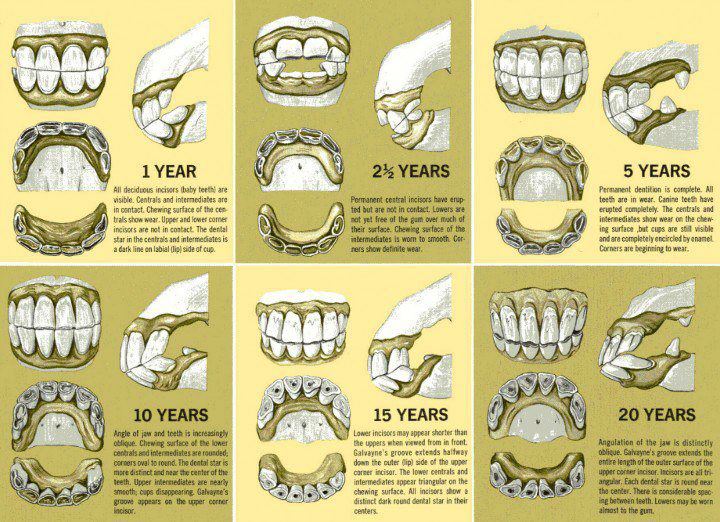
age do horse lose their teeth
At five years , all the deciduous teeth are replaced by permanent teeth, and the horse is called full mouth. Unfortunately, his teeth can only give you an age range rather than the exact number. Aging the horse by its teeth is not an exact science, but changes do occur that can help determine approximate age, and anyone can learn.

Horse's teeth showing development from six years old to extreme old
Here are some basic pointers on aging a horse from its teeth. Like humans, horses get two sets of teeth in their lifetime. Teeth at 6 months ~1 year. I call this group between 13 and 18 years the “adult horses.” Easley describes the tooth characteristics.

Horse Teeth Age Chart
Shape of the surface of the teeth; Assessing an older horse’s age is based on tooth wear, whereas gauging a young horse’s age is based on the teeth present, those being shed and new ones erupting through the gum line. The theory is that the incisor teeth will wear uniformly over time and even within the mouth on each side.
Aging Horse By Teeth Chart - It is an older method, but is still used all around the world. At five years , all the deciduous teeth are replaced by permanent teeth, and the horse is called full mouth. Pride in their ability to determine age by examining the teeth of any horse. Eruption of the corner incisors. To use as a reference guide, figures 1 and 2 indicate the names of the teeth. Three premolars, one permanent molar, and all temporary incisors (6) are present.
To use as a reference guide, figures 1 and 2 indicate the names of the teeth. Assessing an older horse’s age is based on tooth wear, whereas gauging a young horse’s age is based on the teeth present, those being shed and new ones erupting through the gum line. Teeth at 9 months ~2 years Here is how it works. You can also try your hand at this practice by learning what to look for.
Foals Begin To Acquire Teeth During The First Week Of Life.
Development of teeth in foals and young horses follows a definite pattern making it relatively easy to determine the age of the foal or horse by the state of his teeth and their growth. All temporary teeth are present. Adult horses have 24 molar teeth. Additionally, notice the shape of the horse’s incisors at the front of their mouth, since the chewing surface is circular in adult horses and.
Telltale “Hook” On Edge Of Upper Outermost Incisors (Wears Off In 2 Years Then Reappears At Age 11);
Horses under 5 years of age go through some very typical dental changes. Horses have two sets of teeth, one temporary and one permanent. The difference is caused by the horse’s tongue movement, jaw movement or both. Eruption of the lateral incisors.
It Is An Older Method, But Is Still Used All Around The World.
Aging a horse by it’s teeth is a very useful way to accurately identify the age of any horse. At five years , all the deciduous teeth are replaced by permanent teeth, and the horse is called full mouth. With foals a good rule of thumb to remember is that their milk teeth, or deciduous teeth, erupt, or come in, following a simple timetable of 8 days, 8 weeks and 8 months. Outer incisors beginning to wear.
Like Humans, Horses Get Two Sets Of Teeth In Their Lifetime.
To use as a reference guide, figures 1 and 2 indicate the names of the teeth. Until 5 years old, you can tell a horse’s age based on the teeth eruption, which has predictable time frames. Most horses have 24 deciduous (baby) teeth and they appear early — usually within the first two weeks after being born. Horses under 5 years of age go