
Ohms Law Pie Chart
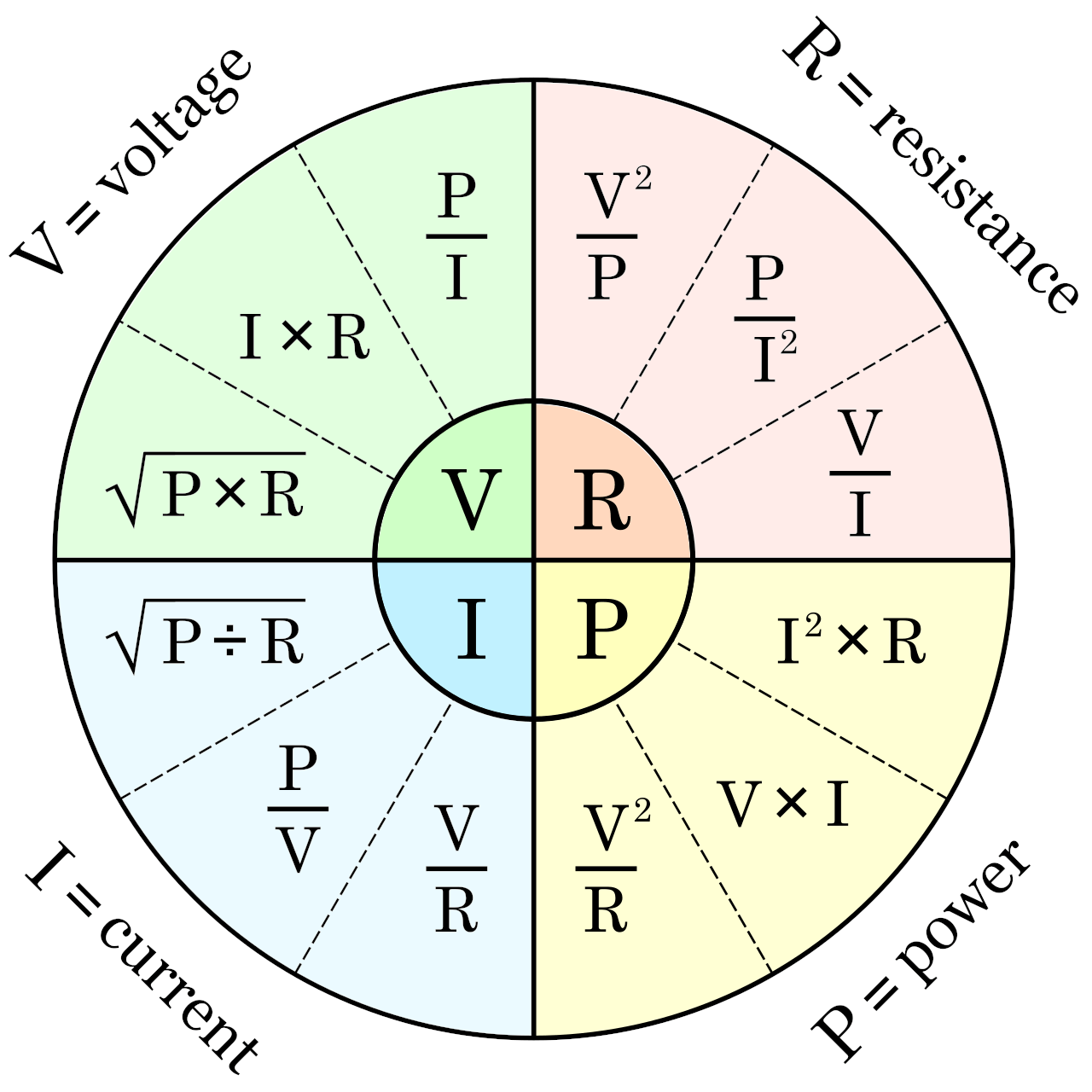
Ohms Law Pie Chart - I would like some feedback to simplify it further, or poke holes in it,. Below is a chart containing the formulas related to ohm’s law. The basic formulas for ohm’s law are summarised in the below ohm’s law pie chart. This pie chart (wheel) modified for ac circuits illustrates relationships between various quantities in linear networks with a sinusoidal input. You can use the formula wheel to calculate values such as voltage, current, resistance, and power. Energy = voltage × charge.
Some like better to stick to e instead to v, so. The combination of ohm's law and joule's law gives us 12 formulas where 2 of the 4 variables are known. The wheel below is a handy tool and memory jogger. Energy = voltage × charge. E means also energy, so let's choose v.

What is Ohm's Law Definition, Formula, Graph & Limitations
E = v × q. You can use the formula wheel to calculate values such as voltage, current, resistance, and power. To use the chart, from the center circle, select the value you need to find, i (amps), r (ohms), e (volts) or p (watts). I would like some feedback to simplify it further, or poke holes in it,. Ohm’s.

Ohm's Law Statement, Formula, Derivation, Applications, Limitations
Below is a chart containing the formulas related to ohm’s law. You can use the formula wheel to calculate values such as voltage, current, resistance, and power. E = v × q. Ohm’s law states that the potential difference (voltage) between two points is proportional to the current flowing through a resistor, and also proportional to the resistance of the.

Ohms Law Chart A Visual Reference of Charts Chart Master
”the amount of current flowing in a circuit made up of pure resistances is directly proportional to the electromotive forces impressed on the circuit and inversely proportional to the total. You can use the formula wheel to calculate values such as voltage, current, resistance, and power. Some like better to stick to e instead to v, so. Ohm’s law states.
Ohm's Law Wheel Printable
”the amount of current flowing in a circuit made up of pure resistances is directly proportional to the electromotive forces impressed on the circuit and inversely proportional to the total. You can use the formula wheel to calculate values such as voltage, current, resistance, and power. In this video, we look at the 12 math equations on the ohms law.

ELEFU Power and Energy
”the amount of current flowing in a circuit made up of pure resistances is directly proportional to the electromotive forces impressed on the circuit and inversely proportional to the total. You can use the formula wheel to calculate values such as voltage, current, resistance, and power. Ohm’s law states that the potential difference (voltage) between two points is proportional to.
Ohms Law Pie Chart - To use the chart, from the center circle, select the value you need to find, i (amps), r (ohms), e (volts) or p (watts). E = v × q. E means also energy, so let's choose v. In this video, we look at the 12 math equations on the ohms law wheel and show you how you can easily remember every formula on the wheel. Energy = voltage × charge. Ohm’s law states that the potential difference (voltage) between two points is proportional to the current flowing through a resistor, and also proportional to the resistance of the circuit.
Some like better to stick to e instead to v, so. I would like some feedback to simplify it further, or poke holes in it,. Below is a chart containing the formulas related to ohm’s law. ”the amount of current flowing in a circuit made up of pure resistances is directly proportional to the electromotive forces impressed on the circuit and inversely proportional to the total. You can use the formula wheel to calculate values such as voltage, current, resistance, and power.
Some Like Better To Stick To E Instead To V, So.
These formulas are adaptations of ohm's law and. ”the amount of current flowing in a circuit made up of pure resistances is directly proportional to the electromotive forces impressed on the circuit and inversely proportional to the total. So i want to present how i have figured out how to remember the entire ohms law pie chart in a simple way. This pie chart (wheel) modified for ac circuits illustrates relationships between various quantities in linear networks with a sinusoidal input.
In This Video, We Look At The 12 Math Equations On The Ohms Law Wheel And Show You How You Can Easily Remember Every Formula On The Wheel.
E = v × q. Ohm’s law states that the potential difference (voltage) between two points is proportional to the current flowing through a resistor, and also proportional to the resistance of the circuit. Energy = voltage × charge. It is correctly represented with an e, since the scientific reference to voltage is electromotive force.
The Basic Formulas For Ohm’s Law Are Summarised In The Below Ohm’s Law Pie Chart.
It shows all of the formulas created from the ohm’s law and pir triangles. To use the chart, from the center circle, select the value you need to find, i (amps), r (ohms), e (volts) or p (watts). The combination of ohm's law and joule's law gives us 12 formulas where 2 of the 4 variables are known. Click on a date/time to view the file as it appeared at that time.
Below Is A Chart Containing The Formulas Related To Ohm’s Law.
V comes from voltage and e from electromotive force emf. You can use the formula wheel to calculate values such as voltage, current, resistance, and power. E means also energy, so let's choose v. I would like some feedback to simplify it further, or poke holes in it,.